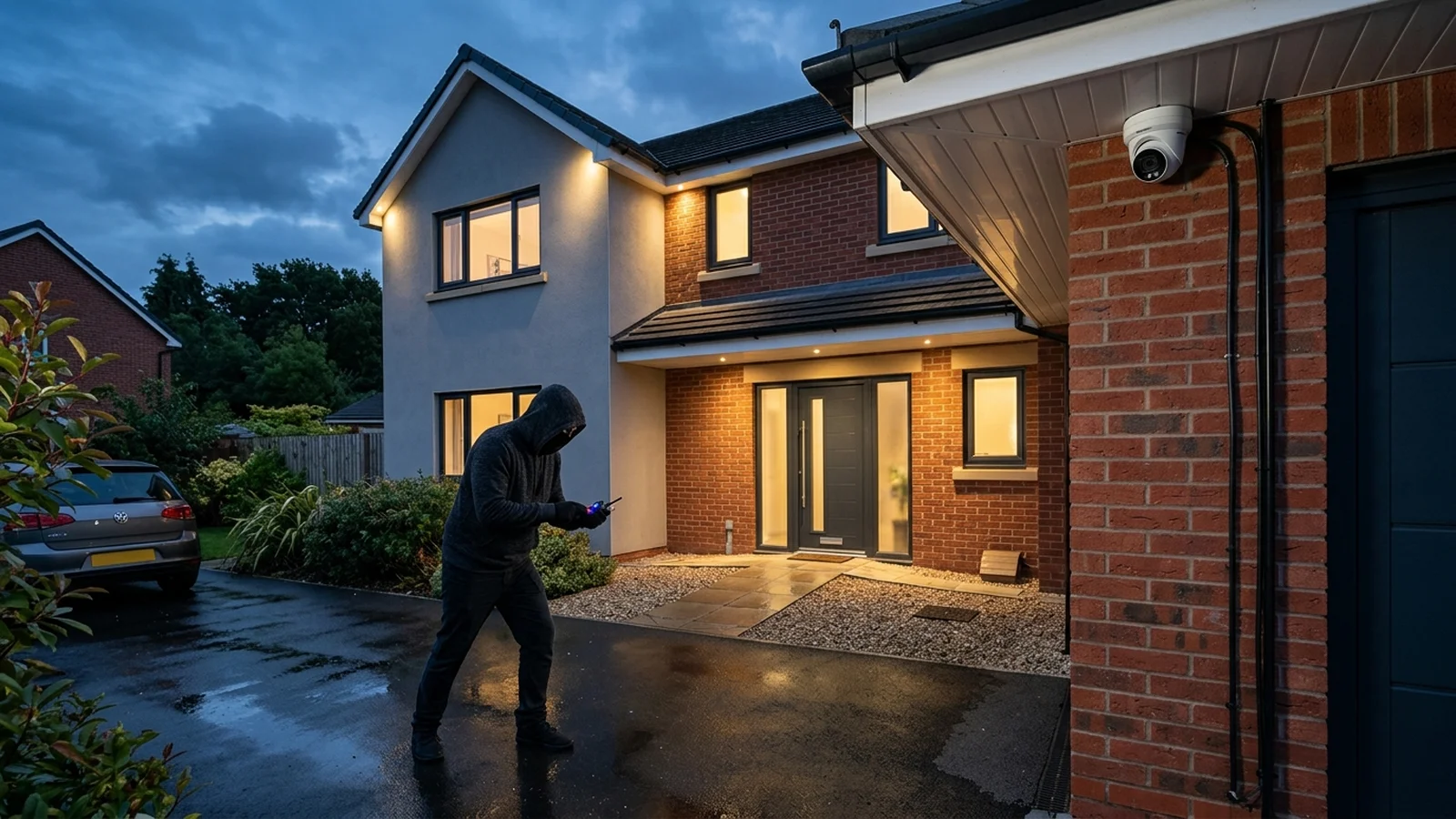

When investigating reports of wireless CCTV jamming in the UK, security engineers and police forensic teams frequently find that consumer battery and Wi-Fi security cameras fail to record critical intrusion footage. Domestic Wi-Fi connections can be severed by 2.4GHz radio frequency interference or de-authentication attacks, while sub-zero British winter weather suppresses lithium-ion discharge rates. Unlike cloud-dependent wireless cameras, hardwired Power over Ethernet (PoE) IP systems isolate video transmission inside solid copper Cat6 cabling and record continuously to a local NVR—eliminating the wireless link vulnerability and providing reliable, uncompressed evidence for police and insurer investigations.
Over the past twenty-four months, domestic surveillance in the United Kingdom has undergone a quiet but severe operational breakdown. Major smart home brands have aggressively marketed wire-free battery cameras as effortless DIY security, promising pristine high-definition perimeter protection with zero drilling. Yet during hands-on security audits across South Yorkshire and the wider UK, our engineering teams routinely encounter property owners who suffered high-value driveway burglaries where not a single second of footage was captured or stored.
To understand why these failures occur, ADI Communications evaluated physical call-out records, router connection logs, and radio-frequency characteristics across residential properties in Yorkshire. For an accessible overview before examining the detailed technical analysis, listen to our educational audio debrief below:
Listen to Gary Pearce's Technical Wireless CCTV Jamming Summary
Prefer listening? Play this educational briefing exploring how RF de-authentication operates at 2.4GHz, cold-temperature lithium battery performance, and why hardwired Cat6 PoE provides continuous local recording.
The primary vulnerability of domestic wireless surveillance stems from the physical limitations of the radio spectrum itself. Unlike commercial installations governed by British Standard BS EN 62676, consumer smart cameras transmit unencrypted 802.11 management frames across crowded 2.4GHz frequencies. Street-level criminals exploit this architecture using pocket-sized transmitters purchased online to execute wireless CCTV jamming, severing video links before motion detection can transmit an alert to the homeowner's smartphone or cloud storage.
To provide structured engineering documentation for homeowners and commercial facility managers, we have collated real-world call-out data, router connection logs, and official UK statutory legislation (Wireless Telegraphy Act 2006 s.68 and the Computer Misuse Act 1990 s.3). The interactive engineering suite below lets you explore equipment vulnerabilities and defense mechanisms:
Explore our interactive technical field investigation assets below to examine the physical reality of 2.4GHz spectrum saturation, deauthentication attack frames, and hardwired PoE defenses:
To deliver clear technical analysis, ADI Communications organized physical installation observations, router connection logs, and manufacturer engineering data into this structured technical investigation. Rather than relying on sales brochures, this engineering hub correlates 25+ years of UK security installation experience with real-world wireless performance characteristics observed during domestic call-outs across Yorkshire.
The interactive modules below provide property owners with practical insight into how wireless signal disruption occurs, how sub-zero temperatures affect battery runtime, and why hardwired Power over Ethernet infrastructure provides resilient, continuous recording.
Forensic Engineering Infographic: Wireless CCTV Vulnerabilities vs Solid Copper PoE
Compiled from bench tests and field installations across Yorkshire, this technical architectural diagram compares the core failure points of over-the-air battery surveillance against the physical isolation of hardwired Cat6 solid copper infrastructure:
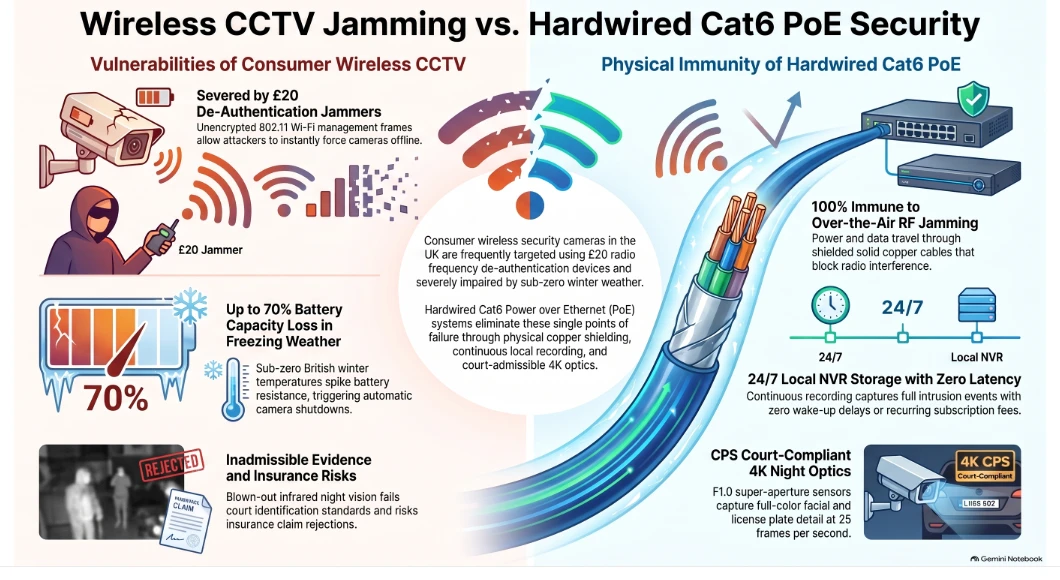
- Deauth Disruption: Exploits unencrypted 802.11 management frames to sever router connections in seconds.
- Cold Weather Degradation: Sub-zero British frost impairs lithium chemistry, suppressing discharge and blocking solar charging.
- Evidentiary Limitations: Blown-out infrared night glare and high compression struggle to meet BS EN 62676 identification standards (250+ px/m).
- Physical Cable Isolation: Power and data travel through solid copper conductors isolated from over-the-air RF interference.
- 24/7 Local NVR Storage: Continuous stream recording directly to surveillance hard drives with zero cloud subscriptions or wake-up delays.
- Identification-Quality Optics: Hikvision ColorVu F1.0 super-apertures capture full-colour nocturnal detail to assist police identification.
1. The £20 AliExpress Weapon: How Wireless CCTV Jamming Works in the UK
Every week across West Yorkshire, Greater Manchester, and the Midlands, homeowners wake up to find their vehicle stolen from the driveway or their garden office ransacked. When they frantically check their smartphone app, expecting a gallery of high-definition video clips, there are no notifications, no cloud recordings, and no motion events. The app simply displays a sterile grey box: "Device offline. Reconnecting to Wi-Fi..."
The homeowner invariably assumes their broadband router glitched or their internet provider suffered a midnight drop. The physical forensic reality is far simpler: their property was targeted by radio frequency de-authentication carried out by intruders using a handheld ESP8266 or Flipper Zero micro-controller executing an 802.11 management frame attack.
Under the IEEE 802.11 Wi-Fi standard—which governs virtually every consumer wireless camera manufactured by Ring, Arlo, Eufy, and Blink—management frames (Type 0, Subtype 12) are transmitted unencrypted by default in standard residential WPA2 networks. While your home network's data payload is protected by WPA2 or WPA3 passwords, the handshaking packets that negotiate device connection status are broadcast openly across the airwaves unless Protected Management Frames (PMF) are strictly enforced by both access point and client. This protocol design allows over-the-air packet disruption to sever wireless links.
An offender standing on the pavement outside your home does not need to crack your Wi-Fi password or hack into your router to sever camera feeds. By broadcasting spoofed "de-authentication" frames at rates exceeding 100 packets per second, the handheld transmitter constantly tells your camera that the router has disconnected it, while simultaneously telling your router that the camera has walked away. The camera enters a perpetual association loop. For cloud-dependent battery cameras without continuous local storage, the video sensor has nowhere to offload data. During active wireless CCTV jamming, footage held in temporary RAM buffer memory is dropped before a single frame ever reaches the Amazon Web Services or Google Cloud recording server.
It is essential to understand the technical boundary between radio frequency interference and protocol de-authentication:
- Physical Layer (Layer 1) RF Jamming: High-power radio transmitters emit raw electromagnetic noise across the 2.4GHz or 5GHz radio bands, drowning out legitimate wireless signals at the physical receiver. This affects all wireless communications in range regardless of encryption.
- Data Link Layer (Layer 2) De-Authentication: Low-cost micro-controllers transmit spoofed 802.11 management frames to trick devices into disconnecting. While IEEE 802.11w Protected Management Frames (PMF) can provide cryptographic authentication to block forged deauth frames when supported and negotiated by both the router and camera, PMF offers no protection against physical Layer 1 noise, and many budget 2.4GHz smart cameras lack PMF support.
- Local Storage Resilience: Certain Wi-Fi cameras featuring encrypted onboard microSD storage or local base station recording can preserve video locally during network disconnects. However, cloud-dependent cameras without local media lose footage completely, and live smartphone alerts remain offline across all models until connectivity is restored.
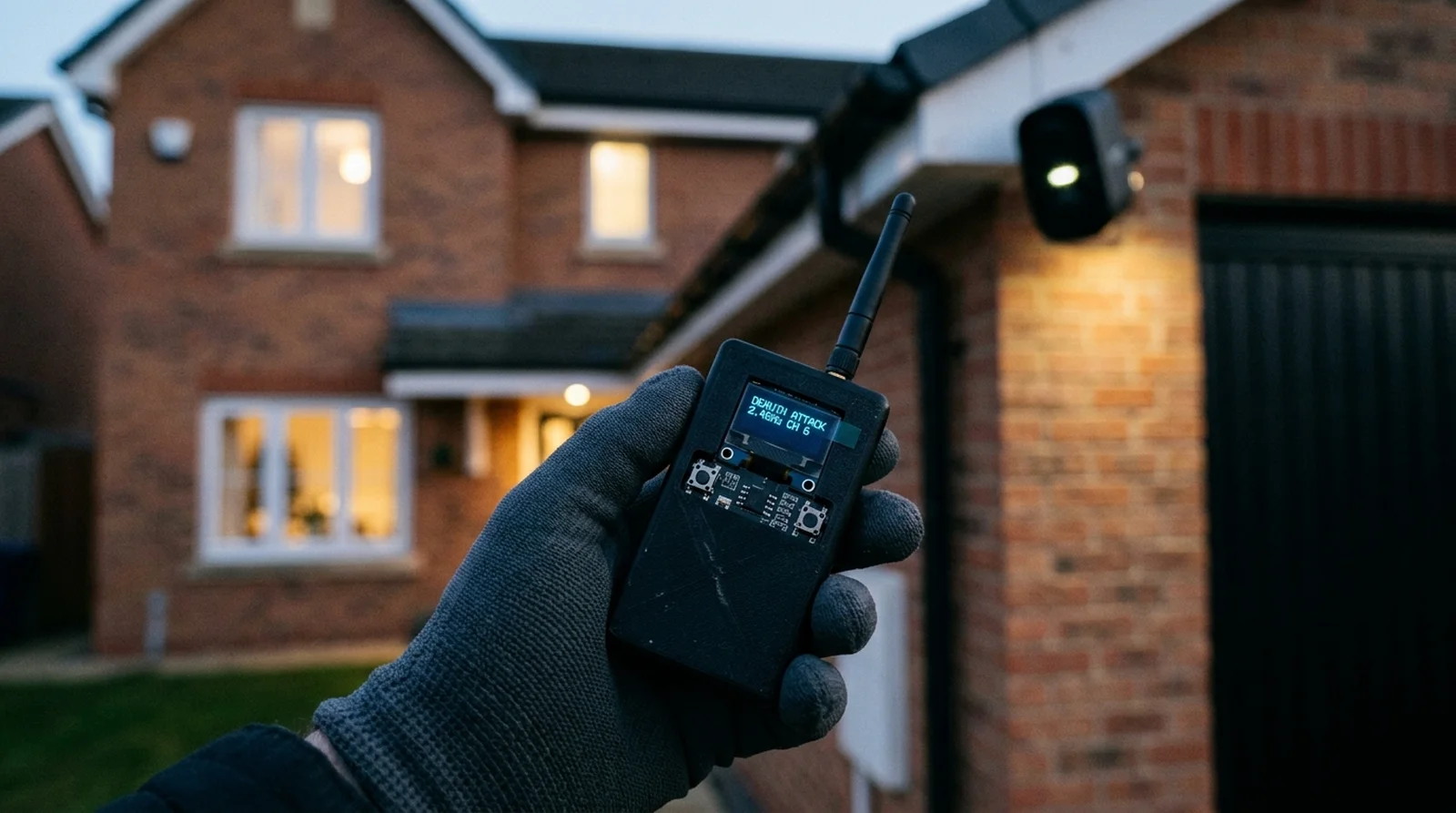
The commercial availability of these portable interference modules creates an acute operational challenge for UK residential security. While military-grade broad-spectrum electronic jammers that overpower entire cellular bands are strictly interdicted at British border ports, compact microcontroller boards such as the ESP8266 and ESP32 configured for wireless CCTV jamming slip through commercial customs unhindered. Overseas dropshippers and online marketplaces openly retail these compact boards disguised under technical descriptions like "IoT development modules," "Wi-Fi packet analysers," or "network penetration testing accessories." Retailing for between £14 and £22, these devices represent virtually zero capital outlay for organized car theft syndicates operating across UK neighbourhoods.
Powered by standard 5V USB battery packs concealed in an offender's jacket pocket, the transmitter emits an unrelenting stream of spoofed 802.11 management frames that drown out legitimate 2.4GHz handshakes across a 20-metre radius. For the homeowner, there are zero overt warnings: no severed cables, no blown consumer units, and no alarm sirens. The camera simply goes offline, displaying a misleading "Device Reconnecting" banner in the smartphone app, while intruders spend crucial minutes duplicating keyless ignition codes or forcing patio doors undisturbed.
To understand how these tools are addressed under UK law, we must examine how British criminal and telecommunications statutes regulate intentional RF interference apparatus.
Section 68 specifically makes it an offence to use any apparatus for the purpose of interfering with wireless telegraphy. Deliberate radio frequency jamming of Wi-Fi or cellular networks is subject to investigation by Ofcom. (Commercial importation, marketing, and non-compliant equipment are separately regulated under radio equipment standards, with UK Government consultations reviewing equipment possession).
Section 3 criminalises unauthorised acts performed with intent to impair, or with recklessness as to impairing, the operation of a computer or network—encompassing malicious 802.11 management packet injection and targeted de-authentication attacks.
2. Representative Case Study: Wireless CCTV Jamming Disconnection Timeline During Driveway Theft
To understand how wireless cameras behave during active signal disruption, we can examine a representative intrusion timeline based on ADI Communications physical call-outs and router connection log audits across Yorkshire residential properties. In this representative scenario, a client's driveway vehicle was stolen while monitored by two branded battery wireless floodlight cameras and a smart battery doorbell.
A technical review of the router's connection timestamps illustrates the typical sequence when over-the-air communication drops:
- 03:15:02 AM: Two offenders enter the outer perimeter on foot. One carries a handheld 2.4GHz transmitter powered by a pocket USB battery bank. Packet injection begins as the device floods the channel with deauth frames.
- 03:15:05 AM: The passive infrared (PIR) heat sensor on the driveway camera detects body heat and triggers the wake-up routine from low-power sleep mode.
- 03:15:07 AM: The camera attempts to establish a TLS handshake with the household router to initiate an AWS cloud video stream. It is hit by repeated de-authentication packets. The wireless handshake is severed immediately.
- 03:15:10 AM: The camera's internal 64MB buffer fills. With nowhere to offload video, the operating system drops frames to prevent processor panic.
- 03:15:22 AM: The second intruder approaches the vehicle window with a keyless relay amplifier. The signal is duplicated; the vehicle unlocks with hazard lights flashing.
- 03:15:48 AM: The vehicle engine starts. The car is reversed out of the driveway and driven off at speed.
- 03:16:30 AM: The offenders leave the perimeter. With radio interference cleared, the battery camera re-associates with the home router and reports "Online".
- 03:16:32 AM: The cloud app issues a motion alert to the sleeping homeowner. The homeowner opens the clip, only to see an empty driveway and an empty space where their car was parked 90 seconds earlier. Due to signal suppression, the critical 75-second theft window recorded zero bytes of footage.
Had this property been protected by a commercial hardwired Power over Ethernet (PoE) camera running Cat6 cable to a continuous Network Video Recorder (NVR), over-the-air signal suppression along the camera link would have been avoided entirely. The entire incident would have been recorded uncompressed at 25 frames per second, complete with 4K color detail, synchronized audio, and vehicle approach vectors.
3. Technical Architecture: RF De-Authentication vs Solid Copper Cat6 PoE
The architectural difference between consumer wireless devices and professional surveillance infrastructure explains why wireless CCTV jamming works so reliably against consumer brands. Where over-the-air signals remain vulnerable to RF packet flood attacks, our professional hardwired CCTV installation services rely on continuous solid-core copper infrastructure. For property owners planning their cable pathways, explore our detailed Power over Ethernet (PoE) home wiring guide. The diagram below contrasts the open 2.4GHz radio frequency broadcast against a physically shielded solid copper Cat6 conduit:
Under the IEEE 802.11 Wi-Fi specification, wireless network communication is divided into three distinct frame categories: data frames, control frames, and management frames. When you configure your wireless camera, encryption protocols such as WPA2-PSK and WPA3-SAE encrypt only the data frames containing video streams and passwords. By contrast, the management frames—specifically subtype 0x000c (De-authentication) and subtype 0x000a (Disassociation)—remain unencrypted and unauthenticated in standard domestic network deployments.
When an intruder initiates wireless CCTV jamming, this fundamental protocol design allows an intruder armed with a budget transmitter to forge management frames bearing your router's spoofed MAC address. When these malicious frames hit the camera, the wireless hardware has no mechanism to verify authenticity and is compelled by protocol standards to sever its connection instantly. With the wireless link broken and zero onboard persistent storage, the camera's capture pipeline fails completely.
4. Technical Field Investigation: Dual-Frequency Security Architecture Breakdown
Why do major electronics retailers promote battery cameras when signal interception risks are well documented in surveillance trade journals? The commercial answer lies in retail margins, consumer DIY simplicity, and recurring subscription revenue.
Review this extended technical study dialogue between Rachel (Consumer Technology Analyst) and Mark (Surveillance Infrastructure Engineer), recorded during testing at the ADI Communications Technical Lab:
"Mark, when consumers invest hundreds in branded battery cameras, they believe signal interception is science fiction. The television adverts show an immediate notification on the owner's phone the moment a prowler touches the driveway. Does that really break down in practice?"
"It collapses instantly. The vulnerability exploits fundamental unencrypted 802.11 management frames. Intruders don't need network passwords. A £20 pocket deauther blasts disconnect frames, forcing the battery camera offline. By the time the homeowner wakes up, the theft is complete and the cloud app shows an empty timeline."
"And how does British winter weather compound these wireless vulnerabilities?"
"Cold weather thickens liquid lithium electrolyte. Below zero degrees, internal electrical resistance spikes, dropping battery capacity by 70%. When RF de-authentication hits an already voltage-sagging battery camera, its microcontroller shuts down completely to prevent deep discharge damage."
"So what is the permanent defense against signal interception?"
"Physical copper. A commercial hardwired Cat6 PoE camera connected to an on-premises NVR with continuous 24/7 local recording. Power and data travel through physical copper pairs, making over-the-air jamming physically impossible."
The technical laboratory debrief above exposes the severe limitations inherent in relying on consumer cloud-tethered surveillance. While consumer marketing highlights wire-free convenience and rapid DIY stick-on installation, domestic security cannot compromise on the physical physics of packet transmission and unbuffered volatile memory.
When malicious RF suppression or wireless CCTV jamming is triggered, the complete lack of persistent on-board recording ensures footage is permanently lost. By contrast, an enterprise-grade commercial system bypasses wireless airwaves entirely, running shielded Cat6 copper cabling straight into a localized Network Video Recorder equipped with continuous surveillance storage.
Technical Reference Guide: Key Takeaways on Wireless CCTV Jamming
Core findings synthesized from UK crime statistics, Ofcom spectrum enforcement records, and ADI physical test laboratories:
802.11 management frames lack encryption, enabling packet injection attacks without cracking network passwords.
Handheld deauth jammers cost under £20 online disguised as developer kits, giving opportunistic thieves military-grade jamming ability.
Liquid electrolyte freezes below 0°C; internal resistance triples and battery cameras miss motion triggers.
Consumer infrared LEDs produce washed-out white facial flares that fail the 250 px/m CPS identification test under BS EN 62676.
Homeowners claiming CCTV insurance discounts risk policy invalidation if wireless signal disruption caused footage loss.
Solid copper Cat6 PoE cabling and local on-premises NVR storage provide 100% physical immunity against over-the-air signal suppression.
Homeowners and property managers across the UK must evaluate their security posture using empirical engineering benchmarks rather than promotional marketing claims. Understanding how 2.4GHz signals propagate, how lithium batteries behave in sub-zero British weather, and how Crown Court evidentiary rules operate is essential before investing in domestic defense.
Use the interactive assessment module below, generated directly from our verified forensic research, to test your comprehension of wireless surveillance vulnerabilities and legal compliance standards.
Technical Assessment: Wireless CCTV Jamming Vulnerabilities
Loading technical assessment...
Understanding the core engineering differences between consumer battery Wi-Fi setups and commercial Power-over-Ethernet (PoE) installations requires mastering specific trade terminology and British Standards.
Review the technical revision flashcards below to reinforce your knowledge of BS EN 62676 pixel densities, de-authentication packet mechanics, and physical copper wiring practices.
Surveillance Engineering Core Protocols Flashcards
Click the card or the flip button below to test your technical comprehension on wireless signal suppression, lithium winter physics, and court-admissible standards:
Loading flashcard...
Answer loading...
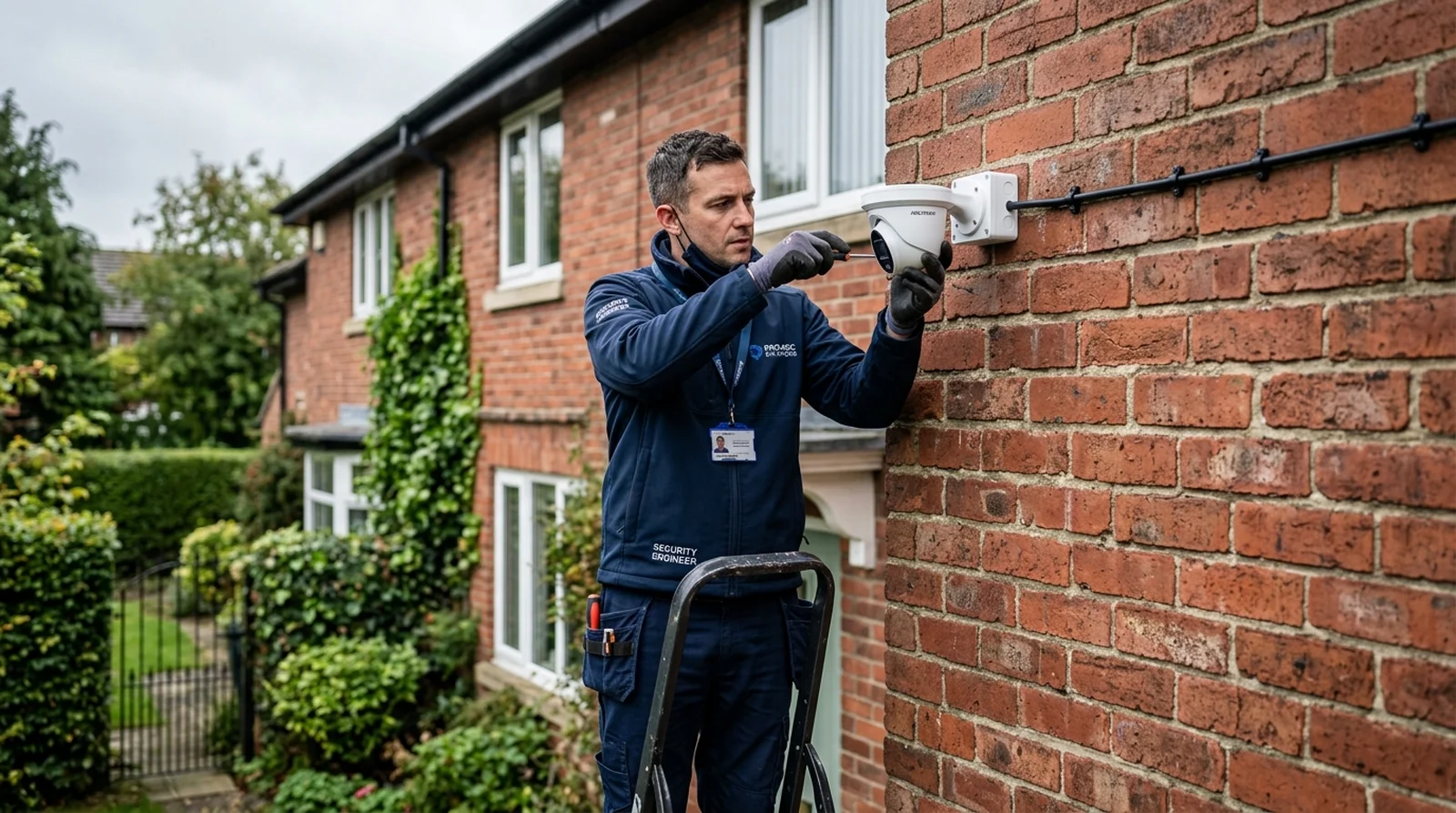
While mastering the theoretical physics of 802.11 management frames and lithium battery thermodynamics is essential for understanding system vulnerabilities, physical engineering on site is where real-world property protection is achieved. Eliminating wireless vulnerabilities requires replacing delicate airwave connections with hardened physical cabling that cannot be jammed, spoofed, or intercepted.
In the photograph below, lead systems engineer Gary Pearce carries out a physical inspection of a commercial Hikvision 4K ColorVu turret camera installed beneath a residential soffit. Utilizing heavy-duty external UV-rated Cat6 solid copper cabling, IP67 weather-sealed deep junction bases, and dedicated Power-over-Ethernet switching, this physical architecture isolates video transmission from wireless CCTV jamming and handheld RF interference.
5. The Forensic 4-Quadrant Comparison: Battery Security Vulnerabilities vs PoE
When evaluating security infrastructure against modern vehicle theft tactics, homeowners must assess physical engineering tolerances rather than consumer marketing brochures. The table below details why wireless cameras collapse under RF de-authentication while hardwired systems remain operational:
| Engineering Vector | Consumer Battery / Solar (Vulnerable to Jamming) | Commercial Hardwired PoE (Immune to Jamming) |
|---|---|---|
| RF De-Authentication Immunity | Vulnerable to 2.4GHz management frame de-authentication attacks. | Physically Isolated. Video data travels inside solid copper pairs. |
| Sub-Zero Winter Resilience | Discharge capacity drops significantly below 0°C; charging disabled to protect cells. | Rated down to -30°C; powered continuously via 48V DC switch. |
| Recording Continuity | Motion clips only (sleeps between motion triggers to preserve battery). | 24/7 Continuous recording with 30-day NVR local hard-drive RAID. |
| Wake-Up Latency | 2.0 to 4.5 seconds delay (often captures intruder's back). | 0.00 seconds delay (pre-record buffer captures approach). |
| Night Vision Sensor Architecture | Standard F2.0 lens with 850nm IR LEDs (grainy monochrome, blown faces). | F1.0 Super Aperture (Hikvision ColorVu) for 24/7 full-colour night footage. |
| 5-Year Cloud Subscription Cost | £300 to £1,200+ in recurring cloud storage fees. | £0.00 (Zero recurring fees; footage resides on your private NVR). |
| CPS Evidentiary Admissibility | Compressed 1080p stream; pixelated compression artifacts. | High-bitrate streams meeting BS EN 62676 identification benchmarks (250+ px/m). |
| Maintenance Burden | Recharging batteries up ladders every 3–6 weeks during UK winter. | Fit and forget; 10+ year lifespan with solid copper conductors. |
6. The Winter Sub-Zero Trap: Why Battery CCTV Cameras Fail in UK Frost
While intentional wireless CCTV jamming accounts for malicious dropouts, British winter weather creates an equally frustrating environmental limitation for battery systems. In consumer cameras, lithium-ion or lithium-polymer cells rely on lithium ions moving through an organic liquid electrolyte between the anode and cathode.
As ambient outdoor temperatures fall below 5°C and approach freezing during British winters, the viscosity of this liquid electrolyte increases and ion diffusion slows. The internal electrical resistance ($R_{\text{int}}$) rises noticeably. When a camera waking from sleep attempts to power high-draw components—such as night-vision LEDs or high-power Wi-Fi transmission—the internal resistance causes an accelerated terminal voltage drop.
The camera's internal microcontroller often misinterprets this sudden voltage drop as a critically depleted battery. To prevent cell damage, firmware may throttle power: lowering motion sensitivity, disabling auxiliary lighting, or failing to initiate recordings.
Furthermore, lithium-ion cells cannot safely be charged at temperatures below freezing without risking metallic lithium plating on the anode, which permanently degrades capacity and increases the risk of internal short circuits. For this reason, manufacturers (including Ring and Arlo) explicitly program firmware charging lockouts whenever battery temperatures drop below 0°C (32°F).
In northern England and Scotland, where winter daytime temperatures routinely hover between -2°C and +3°C with heavy cloud cover and short daylight hours, small solar trickle panels cannot charge frozen cells. Homeowners find themselves climbing ladders in freezing weather to unclip cameras and bring them indoors for recharging.
7. Technical Visualizer: Cold Weather Battery Performance vs Hardwired Cat6 PoE
To visualize how low ambient winter temperatures affect lithium battery runtime and missed event rates compared to wired systems, examine the temperature curve below:
8. Insurer Claim Disputes: Policy Warranties & CPS Court Evidentiary Standards
A frequent inquiry from homeowners across Yorkshire, Cheshire, and Derbyshire is whether home insurance companies require CCTV, and whether recordings survive scrutiny when malicious wireless CCTV jamming occurs.
The commercial insurance position involves two critical legal and technical considerations:
1. The Security Declaration Warranty Clause
When you apply for residential building and contents insurance, many price comparison portals and underwriters ask: "Is the property protected by an approved burglar alarm or CCTV system?" Selecting "Yes" can reduce your annual premium by 5% to 15%. (See our sister investigation into how burglars jam wireless smart alarms across Jeweller 868MHz frequencies).
However, in insurance contracts, declaring security equipment can create a specific policy warranty or condition. You may be contractually obligated to maintain that system in full operating condition. If a break-in occurs while a battery camera was flat or unmaintained, loss adjusters may scrutinize whether policy security requirements were met. Check your individual policy wording carefully to verify whether CCTV is a mandatory warranty condition or an undeclared voluntary precaution.
CPS Evidentiary Guidance & BS EN 62676 Technical Standards
When CCTV footage is presented in support of a UK criminal prosecution, police and the Crown Prosecution Service (CPS) evaluate recordings against British Standard BS EN 62676 (Video surveillance systems for use in security applications). Under official UK surveillance guidelines, camera resolution and coverage are planned according to four operational DORI tiers:
- Monitor (20 pixels per metre): Sufficient only to determine whether a human figure is present.
- Detect (50 pixels per metre): Distinguishes whether an intruder is on the property, but facial features are indistinguishable.
- Recognise (125 pixels per metre): Allows witnesses to say with reasonable certainty whether they have seen the person before.
- Identify (250+ pixels per metre): The target engineering benchmark providing facial detail, clothing texture, and clear vehicle registration numbers required for positive suspect identification.
While BS EN 62676 provides technical planning benchmarks rather than a rigid statutory bar of admissibility (as courts assess evidence on the facts of each case), evidential weight is critical. Consumer wireless battery cameras compress video heavily (often down to 1–2 Mbps bitrate) to conserve Wi-Fi bandwidth and battery power. At night, standard infrared LEDs overexpose facial highlights into flat white discs while losing clothing dye colours. When coupled with dropped frames or disconnection, such footage frequently provides insufficient evidential weight to prove identity beyond reasonable doubt.
9. The False Economy of Cloud Subscriptions: £1,400 over 5 Years
Consumer wireless cameras are marketed with enticing low upfront price tags—often £69 to £149 per unit. What retailers do not highlight is the aggressive ongoing subscription model required to retain your own video recordings, even in the absence of intentional wireless CCTV jamming. (For a transparent breakdown of commercial hardware, hard drives, and labour, consult our detailed UK CCTV installation cost guide).
Without a paid monthly subscription (such as Ring Protect, Arlo Secure, or Nest Aware), consumer cameras disable person detection, restrict event history to mere thumbnails, or refuse to store clips altogether. When you multiply £8 to £15 monthly across five years—combined with the inevitable need to replace degraded lithium battery cells every two years—a four-camera wireless setup costs upwards of £1,400 to £1,800 while remaining exposed to physical theft and over-the-air vulnerabilities.
By contrast, a professional hardwired 4K Power over Ethernet system from ADI Communications starts from £495 fully installed. You own the hardware, the cables, and the local surveillance hard drive outright. There are zero monthly cloud fees, zero subscriptions, and physical cable protection against wireless CCTV jamming.
10. Interactive CCTV Night Vision Lab: 4K ColorVu vs Washed-Out Infrared
The final critical vulnerability of consumer battery cameras beyond signal reliability is optical night performance. Standard battery units rely on weak infrared LEDs that convert nocturnal scenes into grainy, low-contrast black-and-white. Under IR illumination, a navy blue jacket, a black hoodie, and a dark green fleece all look identical.
Commercial hardwired cameras—such as Hikvision ColorVu and Dahua TiOC—utilize massive F1.0 super-aperture lenses and advanced backside-illuminated (BSI) sensors. They capture 400% more ambient photon energy than conventional F2.0 lenses, preserving full 24/7 colour under mere moonlight or distant street lamps.
Field Test: 4K Low-Light ColorVu vs Consumer Infrared Night Vision
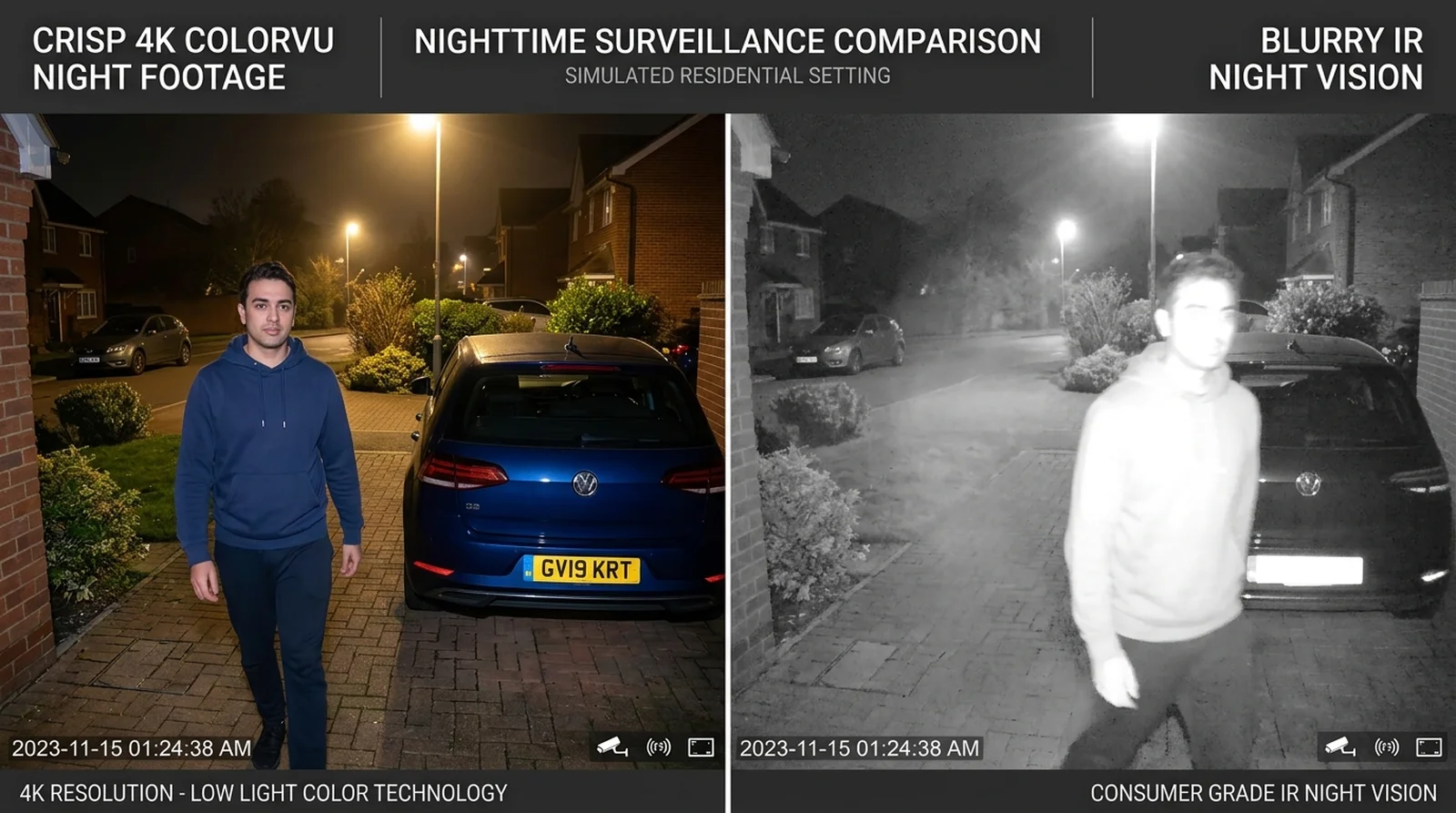
- Vehicle registration GV19 KRT perfectly legible.
- True navy blue garment pigmentation captured accurately.
- Facial identification features crisp; beyond reasonable doubt for CPS.
- Continuous 25fps stream with zero dropped frames during network disruption.
- Number plate washed out into an illegible bright white glare.
- Monochrome IR makes clothing colour identification impossible.
- Facial features blurred and overexposed by close IR bounce.
- Severed if attacker carries a pocket de-authentication device.
11. Concept Architecture Mind Map: Wireless CCTV Failure Modes & PoE Hardwired Defense
Compiled directly from bench testing and trade technical whitepapers, this architectural diagram maps out every vulnerability vector of over-the-air surveillance alongside the solid-copper physical layers required to neutralise them. Use the interactive arrows or domain pills to explore each branch cleanly:
12. The 5-Point Burglary Defense Decision Tree Checklist
Before committing money to home surveillance, run this trade audit on your property's perimeter to evaluate whether your setup is susceptible to modern signal interference:
Interactive Property Vulnerability Audit: Is Your Wireless CCTV at Risk?
Audit Score: 0/5 (Critical Vulnerability)Tick the security features your current perimeter cameras actually possess:
If your property scored less than 3 out of 5, your perimeter relies heavily on unshielded wireless frequencies vulnerable to over-the-air deauth attacks and winter dropouts.