
Is Hikvision Banned in the UK for Homeowners? UK Government Restrictions vs Private Homes, Cybersecurity Hardening & Legal Rules

25+ Years Experience • NVQ Certified CCTV & Data Engineer • £10M Public Liability
Direct Answer (BLUF)
Is Hikvision banned in the UK for homeowners? No. Hikvision CCTV cameras are not generally prohibited for private household use in the UK. The government restrictions announced in November 2022 by the Cabinet Office concerned deployment on sensitive government sites subject to China's National Intelligence Law, not a blanket ban on homeowners buying or using Hikvision equipment. As with any internet-connected security system, domestic safety depends on proper cybersecurity, firmware maintenance, and data protection compliance under UK domestic CCTV laws.
1. The UK Government Ban: Who Is Actually Affected?
Do you want to know if Hikvision cameras are banned in the UK? Many homeowners ask this question every week following high-profile media headlines. Some online forums suggest that using these cameras on private homes is unlawful. That is not the case.
In November 2022, the UK Cabinet Office issued a formal procurement direction to central government departments. The directive instructed government bodies to cease deploying visual surveillance equipment manufactured by companies subject to China's National Intelligence Law on sensitive government sites. Furthermore, departments were instructed to disconnect such existing systems from core administrative networks. The official policy rationale was to mitigate potential security and supply chain risks across national security, defence, and critical Whitehall infrastructure.
Security officials, ministers, and parliamentary committees have repeatedly made this distinction clear: the restrictions relate specifically to central government procurement and deployment on the sensitive state estate. The direction does not introduce a statutory ban on private residential homeowners, landlords, or private businesses buying, installing, or operating Hikvision or Dahua equipment on private property.
For UK householders, the legal framework governing CCTV is overseen by the Information Commissioner’s Office (ICO) under the UK General Data Protection Regulation (UK GDPR) and the Data Protection Act 2018. The law is concerned with protecting individual privacy, ensuring fair processing, and preventing unlawful surveillance across domestic boundaries—not with restricting specific commercial manufacturer brands. You can review our detailed guide on UK domestic CCTV laws and neighbour privacy for exact boundary rules.
A subsequent parliamentary debate arose when industry marketing suggested the UK rules amounted to an official government endorsement of specific commercial brands. Ministers and the Surveillance Camera Commissioner clarified that the state does not endorse or approve any private surveillance brand. However, the legal position for private citizens remains unequivocal: buying and operating Hikvision or Dahua cameras for your private home is fully lawful in the UK.
2. Is Hikvision or Dahua Safe for Home Use? Hardware vs Configuration Risk
Many online debates focus on hidden backdoors in camera hardware. But after 25 years on the tools across Yorkshire, I see a very different reality. The real danger to your home is not the logo on the camera. The real threat is poor network setup.
Web bots do not need secret backdoors to hack a camera. They look for open router ports, weak factory passwords, and old firmware. A lazy setup leaves your home wide open. When we install a professional CCTV installation, we close every door to external hackers.
CCTV Network Architecture: Unsafe vs Hardened Deployment
[ Public Internet ]
└── Open Ports: 80 / 554 / 8000 / UPnP Enabled
└── Standard Home Broadband Router
└── IP Cameras & NVR Exposed to Shodan Crawlers
Automated scanners find the open web interface within minutes. If passwords are weak, automated bots recruit the recorder into a botnet. This happens within minutes.
[ Public Internet ]
└── Broadband Router (UPnP OFF • Zero Port Forwards)
└── Authenticated P2P Cloud Relay / WireGuard VPN
└── NVR Backplane Physical PoE Subnet (172.16.x.x)
Cameras have zero direct route to the internet. The NVR operates on an air-gapped internal switch. External access occurs only via encrypted, authenticated tunnels.
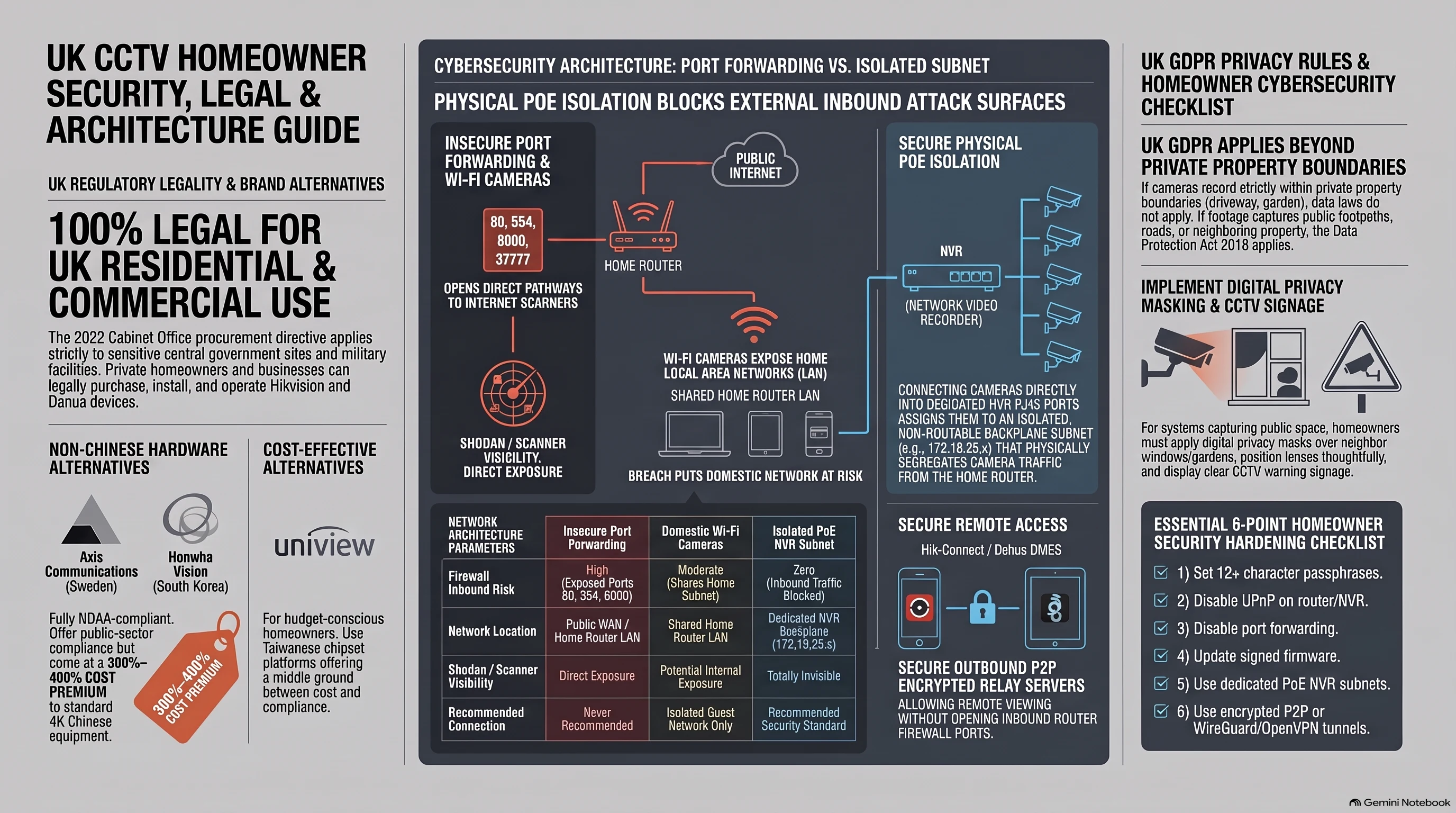
The single biggest vulnerability in residential CCTV is enabling UPnP or forwarding ports in your broadband router. Never open inbound ports like 80, 554, or 8000 to the public internet. When these ports are opened, search tools like Shodan and automated vulnerability scanners discover the recorder's web interface within minutes, subjecting it to automated credential-stuffing and known exploit scripts.
By keeping your recorder on an isolated network with zero open inbound ports, automated web crawlers cannot discover it directly from the public web.
A premium western-manufactured camera with an open router port carries significant exposure. Conversely, a Hikvision or Dahua system placed on an isolated physical subnet with zero port forwarding has a dramatically restricted attack surface. Network configuration is an essential pillar of CCTV security: disabling unnecessary port forwarding, securing remote access via outbound P2P relays or WireGuard VPN, and applying manufacturer firmware updates reduces exposure to a minimum, though no internet-connected device is ever 100% risk-free.
At ADI Communications, we never configure inbound port forwarding. We connect IP cameras directly to the internal PoE switch ports on the back of the recorder. This gives each camera a private, non-routable IP address (such as 172.16.x.x) that cannot communicate with your home computers or the public web directly. Live remote viewing is handled exclusively via secure, outbound encrypted P2P tunnels or an on-premise VPN gateway.
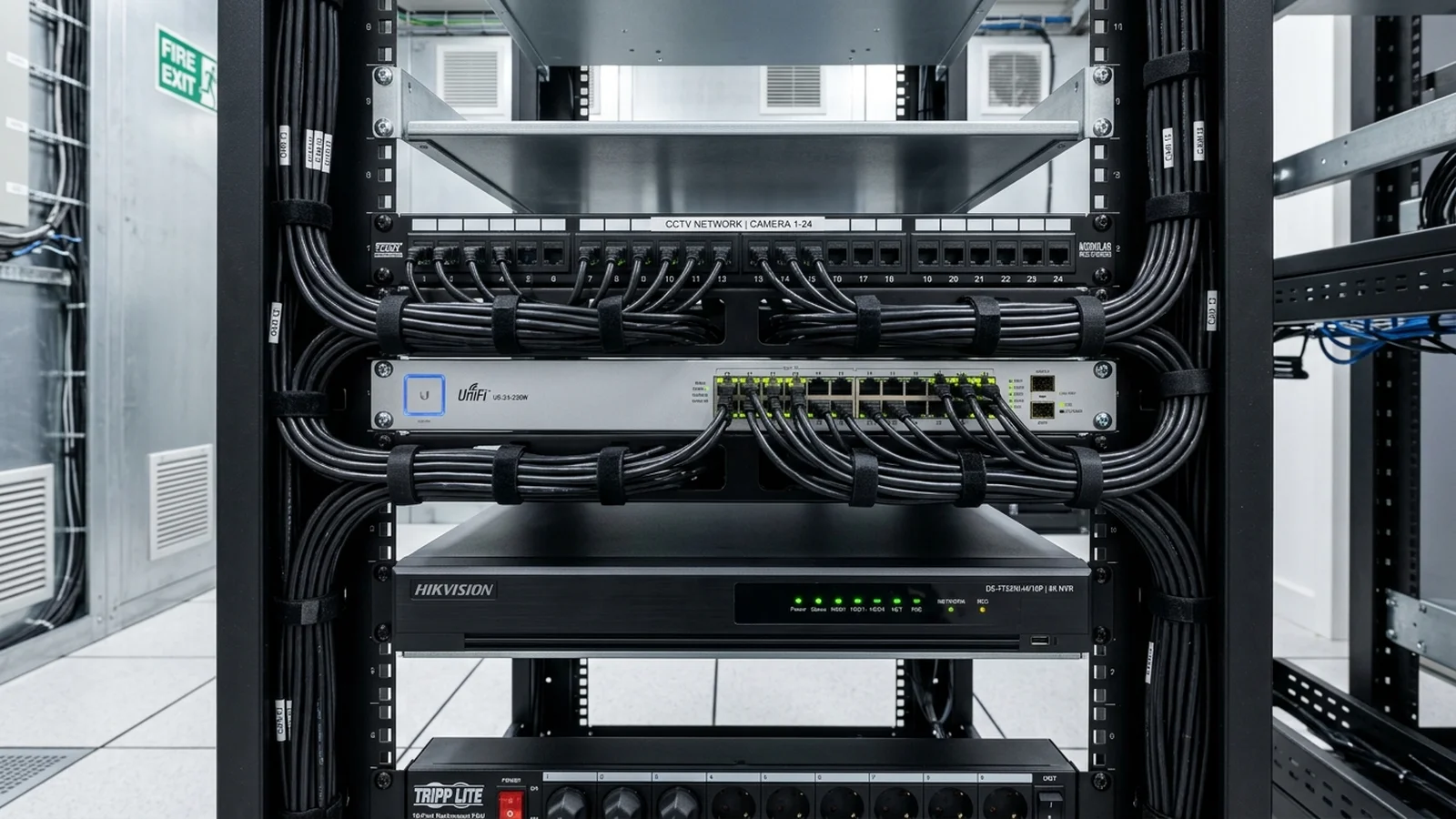
CCTV Network Exposure vs Hardened Isolated PoE Subnet Flow
Physical signal flow comparing direct router port exposure against an isolated commercial NVR backplane.
3. The 7-Point CCTV Cybersecurity Hardening Protocol
Any CCTV system must be locked down tight before going live. We follow a strict 7-point trade checklist on every job:
Enforce Strong Passwords & Lockout Rules
We create random 16-character passwords with letters, numbers, and symbols. We set lockout rules after five failed tries.
Turn Off Old Daemons (Telnet & SSH)
We turn off Telnet and SSH ports on all devices. No test ports stay open.
Stop Auto-Discovery (UPnP & Bonjour)
We turn off UPnP, Bonjour, and SNMP. Devices stay completely hidden..
Block Inbound Port Forwarding
Never open ports on your broadband router. We use secure P2P cloud relays or WireGuard VPN tunnels.
Turn On Web Encryption (HTTPS & TLS)
We turn on HTTPS with TLS certificates to guard internal video streams and passwords.
Keep Firmware Fresh with Signed Builds
We install official signed firmware to patch known bugs and seal security holes.
Use Private Subnets & Isolated VLANs
We connect cameras straight to the recorder backplane. We use an isolated VLAN to stop data leaks.
UK CCTV Homeowner FAQs: Ban Reality, Shodan Probes & Isolated PoE Defense
Watch this authoritative field engineering guide answering homeowner FAQs on the UK ban, router port risks, and isolated NVR defense.
Incoming automated crawler scanning IPv4 address space on port 8000 and 554...
Result: Zero ACK packets returned. Scanner logs host as OFFLINE. Probe safely deflected.
"People worry about the manufacturer brand on the box, but in 25 years on the tools, the vast majority of compromised residential recorders I have investigated were breached because someone forwarded port 8000 or left UPnP active on their broadband router. Put your cameras on an isolated PoE subnet, use authenticated cloud P2P, and you eliminate the primary exposure paths that automated scanners exploit."
Interactive CCTV Security & Hardening Report
Generate your personalized ADI trade security assessment report
4. Brand Face-Off: Hikvision vs Dahua vs Uniview vs Reolink
Homeowners often ask which brand an installer would fit on their own home. The market splits into pro trade gear and budget DIY kits.
The table below compares the top four brands. It covers build quality, warranty, and AI smarts. If you want a detailed side-by-side camera analysis, see our test on Hikvision ColorVu vs Dahua TiOC night vision.
| Feature / Metric | Hikvision | Dahua | Uniview (UNV) | Reolink |
|---|---|---|---|---|
| Market Tier | Commercial / Trade | Commercial / Trade | Commercial / Trade | Consumer / Retail DIY |
| Installer Popularity | Very High (Industry Standard) | Very High (Direct Rival) | Rapidly Rising in UK | Low Among Trade Fitters |
| Core AI Analytics | AcuSense (Human/Vehicle) | WizSense SMD 4.0 | LightHunter / Wise-ISP | Basic Smart Detection |
| Night Vision Quality | ColorVu (F1.0 Super Aperture) | TiOC / Full-color Technology | ColorHunter Technology | Color Night / White Spotlight |
| Chassis & Enclosure | Rugged Die-Cast Aluminium | Rugged Die-Cast Aluminium | Commercial Cast Metal | Predominantly Plastic/Hybrid |
| NVR Network Subnet | Dedicated Isolated PoE Subnet | Dedicated Isolated PoE Subnet | Dedicated Isolated PoE Subnet | Basic Shared Home Network |
| UK Trade Warranty | 3 to 5 Years Advance RMA | 3 to 5 Years Advance RMA | 3 Years Trade Warranty | 2 Years Consumer Retail |
Why do certified installers pick Hikvision, Dahua, or Uniview over Reolink?
First is deep-learning target classification. Hikvision AcuSense and Dahua WizSense use dedicated onboard neural processors to distinguish human silhouettes and vehicles from benign environmental triggers like spider webs, rustling foliage, and heavy rainfall. When properly calibrated for scene lighting and detection zones, this significantly reduces nuisance push notifications compared to basic pixel-change motion detection.
Second is fast trade warranty support. Trade brands have dedicated UK distributors. If a camera fails, we swap it over the counter the next morning. You get a full 3 to 5-year trade warranty. DIY brands require slow post returns.
Third is rugged metal housing build. Pro cameras use heavy cast alloy bodies and tough glass. They survive harsh British winters for ten years or more. Budget units use plastic cases that fade and crack in the sun.
5. Mixing Hikvision Cameras on a Dahua NVR: The ONVIF Trade-Off
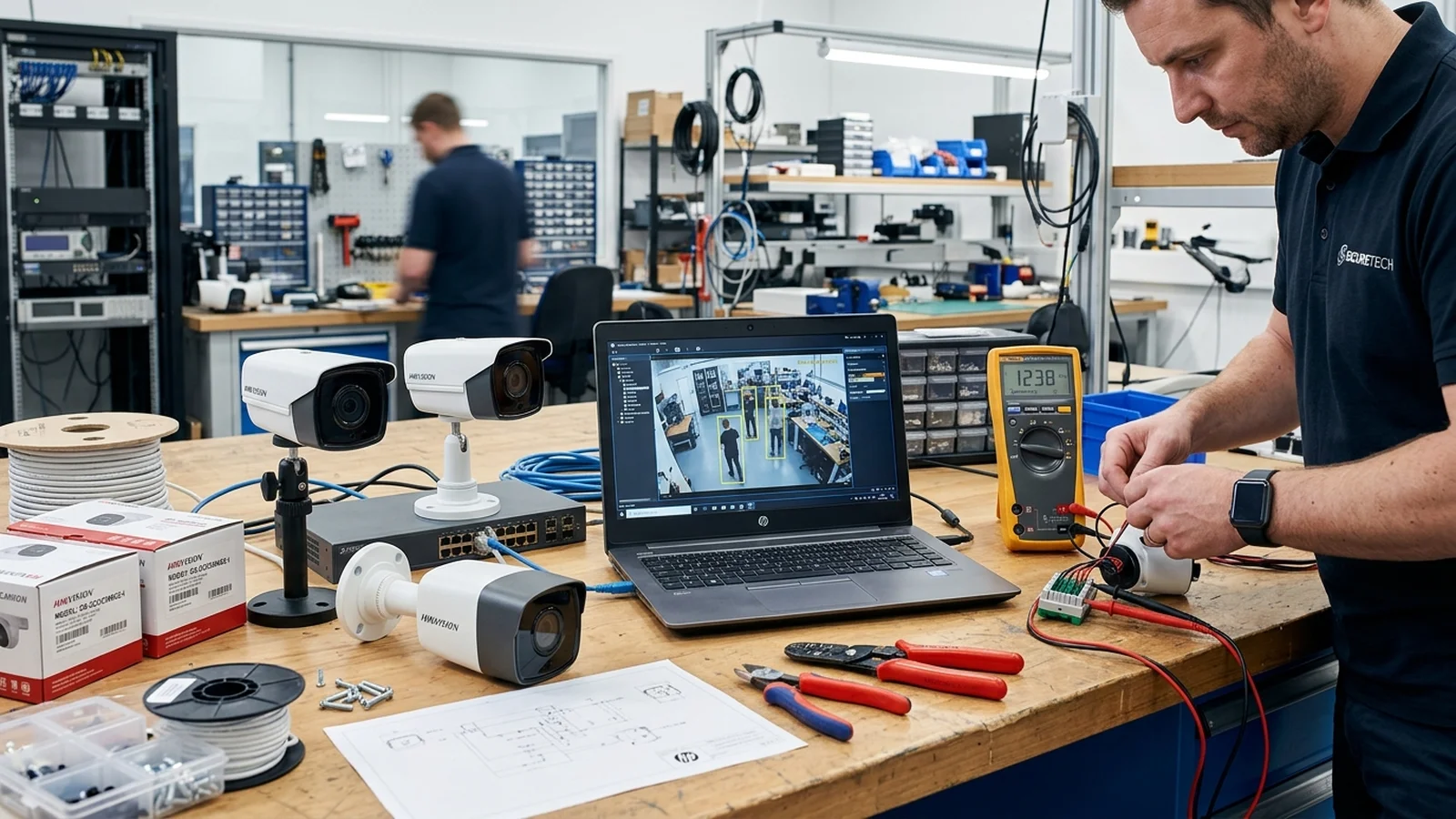
Can you plug a Hikvision camera into a Dahua recorder? Yes, you can. You use the ONVIF Profile S link. But you lose the best features of both brands.
The camera will stream basic video and record sound. But you lose smart AI event data. A Dahua recorder cannot read Hikvision AcuSense tags. The recorder falls back to basic pixel motion. Every gust of wind through a tree sets off an alert.
Cross-Brand ONVIF Integration: What Works vs What You Lose
What Still Works (ONVIF Profile S):
- Continuous H.264 / H.265 video stream recording
- Audio stream ingestion from camera microphone
- Basic pixel-change motion detection recording
- Manual snapshot exports to USB drive
- Basic sub-stream live view on mobile apps
What You Permanently Lose:
- AcuSense / WizSense AI human & vehicle target metadata
- Smart timeline search (cannot filter "cars only" during playback)
- Centralized camera parameter setup (WDR, shutter, night mode)
- Active deterrence triggers (TiOC sirens and flashing red/blue strobes)
- One-click remote firmware upgrades from the NVR interface
You also lose smart timeline search. You cannot ask the recorder to show only cars or people. If an incident happens, you need fast evidence. Without smart search, you must scrub through hours of footage manually. For step-by-step export rules, read our guide on how to save CCTV footage for the police.
Our rule is simple: always match your recorder brand to your main cameras. If you must mix brands, put the odd camera in an outbuilding. Use it where smart AI alerts do not matter..
6. The "8K" CCTV Confusion: 8MP vs True 8K Security Cameras
Many online sellers advertise 8K security cameras. Homeowners ask if they should buy an 8K kit. We need to clear this up. An 8MP camera is a 4K camera, NOT an 8K camera.! Calling an 8MP camera 8K overstates the pixel count by four times. You can explore the full breakdown in our 8K CCTV camera price and truth guide.
Resolution Reality: 1080p vs 4K (8MP) vs True 8K (33MP)
1920 × 1080 pixels. Baseline clarity. Adequate for small rooms, poor for distant vehicle number plates.
3840 × 2160 pixels. The modern residential standard. Delivers high pixel density (250+ px/m identification standard) across typical driveways and entry gates depending on lens focal length and scene lighting.
7680 × 4320 pixels. Enterprise stadium & airport tracking. Extreme storage bitrates (40-60 Mbps per stream).
A 4K camera records at 3840 by 2160 pixels. That equals 8.3 million pixels (8MP). True 8K resolution requires 7680 by 4320 pixels. That is 33 million pixels (33MP).
True 8K security cameras exist, but they make little sense for a home. First is massive storage demand. A single true 8K camera uses 40 to 60 Mbps of data. A 4-camera system fills an 8TB hard drive in just a few days.
Second is poor night vision. As you pack more pixels onto a small sensor, each pixel shrinks. Smaller pixels catch less light. In dark British winters, a 33MP sensor creates digital noise and blurry images.
A pro 4K camera with a large sensor and an F1.0 lens—like Hikvision ColorVu or Dahua Full-color—gives bright, sharp colour video in low light. Good glass and big sensors beat raw megapixel numbers every time.
7. Non-Chinese CCTV Alternatives in the UK: The Cost Trade-Off
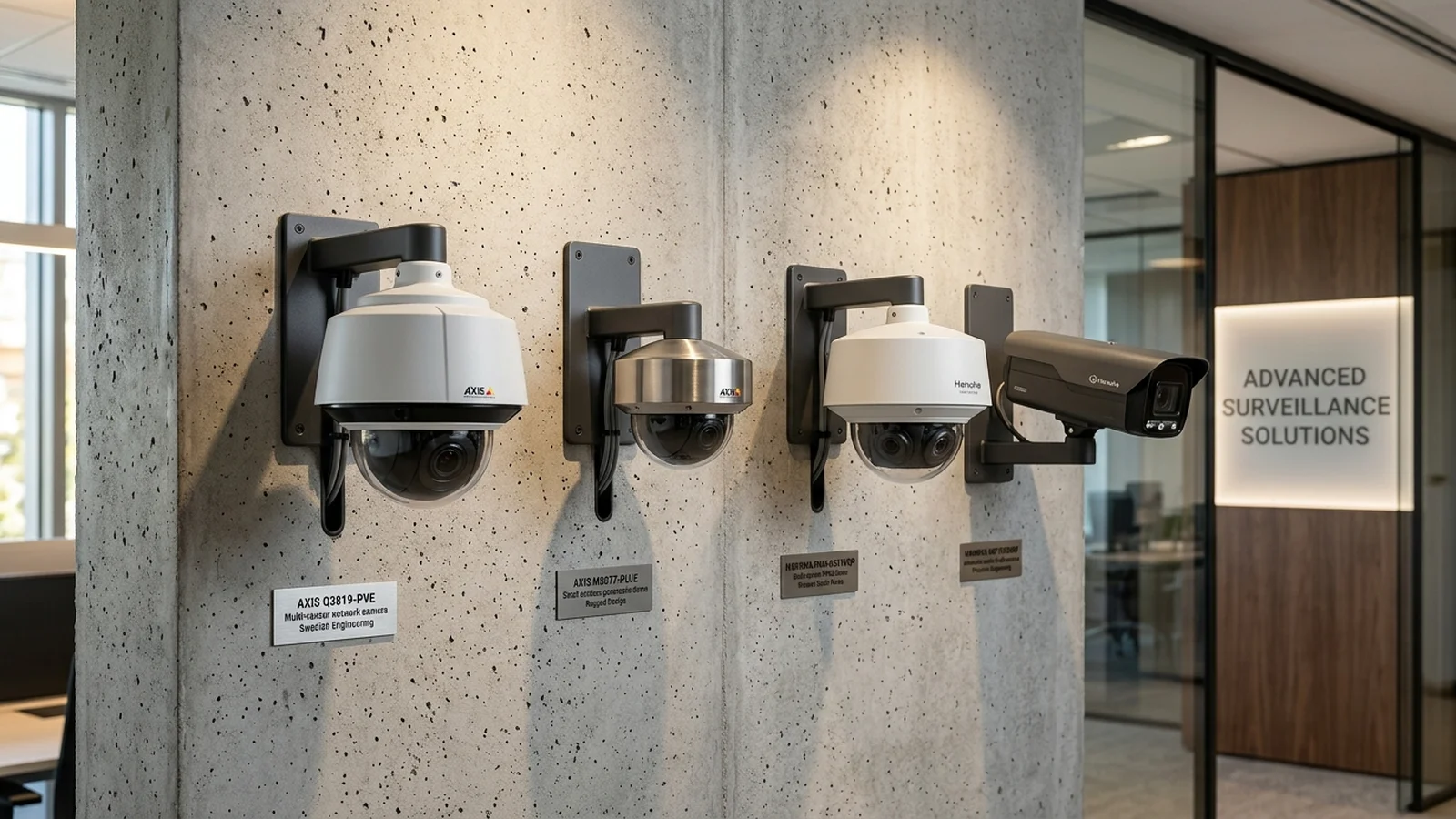
Some clients prefer not to use Chinese cameras. There are strong brands from South Korea, Europe, and America. Hanwha Vision from South Korea uses custom chips and meets strict NDAA rules. Axis from Sweden is the gold standard for video gear. Pelco and Bosch also build rugged enterprise cameras.
Hanwha Vision (South Korea)
South Korea • NDAAFormerly Samsung Techwin. Hanwha designs and manufactures its proprietary Wisenet WN7 chipsets in South Korea and Vietnam. Features hardware Secure Boot and mutual authentication. It meets full US NDAA standards.. The leading commercial alternative to Hikvision and Dahua in the UK.
Axis Communications (Sweden)
Sweden • Canon GroupThe global gold standard in IP video surveillance. Founded in Sweden and owned by Canon, Axis designs proprietary ARTPEC silicon in-house. Outstanding low-light forensic imaging, industry-leading 10-year firmware support lifecycles, and cryptographic hardware ID modules. Premium pricing reflecting enterprise engineering.
Pelco (USA / Motorola Solutions)
USA • Motorola SolutionsAn American security pioneer now owned by Motorola Solutions. Hardened against physical and digital tampering. Pelco builds high-security IP cameras with TLS encryption. They link smoothly with enterprise video platforms..
Bosch Security Systems (Germany)
Germany • IndustrialRenowned for German precision engineering and industrial build quality. Bosch IP cameras feature built-in video analytics and on-board TPM security. They deliver sharp image stabilization on high-risk commercial sites..
From an investment standpoint, hardware costs represent a significant difference for homeowners. As an indicative baseline, professional 4-camera 4K trade hardware from Hikvision or Dahua typically ranges from £450 to £750 plus VAT for core hardware. In contrast, comparable enterprise-grade NDAA ecosystems from Hanwha Vision or Axis Communications generally range between £1,600 and £3,200 plus VAT (excluding advanced VMS camera licensing and specialist installation).
For critical national infrastructure and government procurement, paying this premium is a mandatory statutory standard. For an ordinary private residence, however, implementing physical network isolation and eliminating public router port exposure substantially mitigates common external threat vectors without requiring enterprise commercial budgets.
8. Mobile App Experience: Hik-Connect vs Dahua DMSS vs Imou Life
Most family members use their phones to check the cameras. Which app is easiest to live with?
Dahua DMSS (Recommended for Everyday Simplicity)
Google Play & Apple StoreDMSS is Dahua’s flagship mobile app. It delivers rapid push alerts with crisp preview images. You can see why an alert fired without opening the live stream.. For TiOC cameras, DMSS gives you one-tap controls. You can arm, disarm, or trigger flashing lights and sirens instantly.. Most importantly, it is fully downloadable and updateable directly from both the Google Play Store and Apple App Store.
Imou Life (Dahua’s Consumer-Tailored App)
Simplified Family SharingImou is Dahua’s consumer-facing sub-brand. The Imou Life app is streamlined with simplified menus, removing technical networking jargon. It is exceptionally well-suited for elderly relatives or non-technical family members who only need to view live streams and check driveway activity.
Hik-Connect (Powerful Ecosystem with Alternative Android Distribution)
Direct App Store & Galaxy StoreHik-Connect is an incredibly comprehensive platform that unifies CCTV cameras, video intercom doorbells, and AX PRO intruder alarm panels into a single app. On Apple iOS devices, Hik-Connect installs directly from the Apple App Store. On Android devices, following its removal from Google Play, Hikvision distributes the application through the official Hikvision App Store and the Samsung Galaxy Store. While simple to keep updated via built-in auto-updates once installed, this direct distribution requires initial browser permission, which can feel less familiar for non-technical users. If you prefer a separate dedicated alarm with seamless cloud management, explore our Ajax wireless smart alarm installations.
Dahua DMSS is our pick for everyday domestic ease. It delivers rapid event alerts with clear video preview thumbnails. You can mute or sound sirens with one tap. You download it directly from both the Google Play Store and Apple App Store.
Imou Life is Dahua's streamlined domestic app. It strips out complex network menus and makes sharing camera streams with family members effortless.
Hik-Connect remains a feature-rich, high-performance platform linking cameras, video doorbells, and intruder alarms. On Android, installing it via the Hikvision App Store or Samsung Galaxy Store requires initial download permissions. For householders who prefer standard Google Play Store updates on every phone, Dahua DMSS provides the simplest out-of-the-box experience.
9. UK GDPR & Residential CCTV Legal Compliance (2026 Checklist)
Under UK law, householders have a clear legal right to install CCTV to protect their homes and families. However, the legal position shifts if your cameras capture images of people beyond your private property boundary—such as neighbours' gardens, shared driveways, or public pavements.
In these circumstances, your system is no longer covered by the domestic exemption and becomes subject to the UK General Data Protection Regulation (UK GDPR) and the Data Protection Act 2018, regulated by the Information Commissioner’s Office (ICO). Homeowners must follow the statutory principles set out in the official GOV.UK Domestic CCTV Guidance:
UK Domestic CCTV Data Protection & Privacy Obligations
If your cameras overlook a public street, pavement, or shared pathway, you must clearly inform people that recording is taking place. Display clear, visible warning signage that includes your contact details so individuals know who operates the system.
Only capture the footage strictly necessary for domestic security. Position cameras carefully and use digital privacy masking in your NVR settings to black out neighbouring windows, patios, or private living areas so that private spaces are not recorded.
Do not store footage indefinitely. Set your recorder to overwrite footage automatically after a reasonable retention period (typically 14 to 30 days unless needed for an active police investigation). Ensure recorded data is password-protected and accessible only to authorized household members.
Anyone recorded by your cameras beyond your property boundary has the legal right to request a copy of their footage. Under UK data laws, you must respond to valid Subject Access Requests within one calendar month and provide the footage free of charge, ensuring third parties are redacted if necessary.
By implementing accurate camera alignment, hardware-level privacy masks, and isolated NVR networking, homeowners achieve robust security while remaining fully compliant with UK data protection legislation and maintaining good community relations.
How Home Security Cameras Invite Hackers: Router Hardening & Brand Forensics
Listen to our field briefing detailing the exact scope of the UK Cabinet Office directive, router port forwarding security risks, cross-brand ONVIF limitations, and why network isolation is paramount for home security.
UK CCTV Homeowner Security & Compliance Knowledge Check
Test your understanding of UK camera ban regulations, router port forwarding security risks, and isolated PoE subnet hardening.
Under the 2022 UK Cabinet Office procurement directive, which sector is explicitly prohibited from installing Hikvision and Dahua equipment?
What is identified as the primary security vulnerability leading to CCTV external compromise?
How does connecting IP cameras directly to an NVR's isolated PoE backplane protect your home network?
What is the primary trade-off when mixing different camera brands on an NVR via the ONVIF open standard?
Comprehensive CCTV Regulations & Network Architecture Study Guide
Exhaustive engineering debrief covering statutory UK compliance, physical PoE subnet isolation, ONVIF limitations, and optical resolutions.
1. UK Statutory Scope: Cabinet Office Directive vs Residential Law
The 2022 UK Cabinet Office procurement directive was issued to address supply-chain risks on sensitive central government sites and critical state infrastructure. The restriction does not apply to private residential homeowners, landlords, or general commercial businesses. Operating Hikvision, Dahua, or Uniview equipment on private homes remains fully lawful under UK law.
2. Vulnerability Root Cause: Inbound Port Exposure vs Isolated PoE
Field investigations and cybersecurity research indicate that the overwhelming majority of domestic CCTV compromises stem from exposed inbound router ports (such as 80, 554, 8000, or 37777), active UPnP, and weak passwords rather than manufacturer backdoors. Connecting cameras directly to an internal PoE NVR switch creates an isolated private backplane with zero direct public routing, drastically shrinking the attack surface.
3. The ONVIF Trade-Off Matrix
While Profile S and T allow basic video transmission between mixed manufacturers, brand-specific neural networks (Hikvision AcuSense and Dahua SMD) rely on proprietary metadata tags. Cross-brand mixing disables false-alarm vehicle/human classification and active strobe deterrence.
4. Optical Resolution Standards: 8MP (4K) vs 8K
An 8MP sensor records at 3840×2160 pixels (4K Ultra HD), providing pristine optical forensic identification up to 20 metres. True 8K requires 33MP (7680×4320 pixels), which creates severe storage overhead and low-light noise penalties unsuitable for standard domestic night illumination.
Frequently Asked Questions About Hikvision, Dahua & UK CCTV
Below are the most common questions homeowners and property managers ask us regarding UK CCTV regulations, Chinese brand bans, and cybersecurity hardening:
Is Hikvision banned in the UK for homeowners?
Can I legally buy Hikvision cameras in the UK?
Do homeowners have to remove existing Hikvision cameras?
Why did the UK Government restrict Hikvision equipment?
Are Hikvision cameras safe when connected to the internet?
Is Dahua safe for home CCTV use in the UK?
Can you mix a Hikvision camera on a Dahua NVR?
What are the best non-Chinese CCTV alternatives in the UK?
Why do professional installers prefer trade brands over DIY cameras?
Which app is easier for families: Hik-Connect or Dahua DMSS?
Does UK GDPR apply to home CCTV cameras?
Verified UK Regulatory & Technical Sources
This guide was researched, authored, and fact-checked by Gary Pearce (Lead Systems Engineer, 25+ years field experience). Last verified: October 2026. Statements regarding UK procurement policy and domestic data protection are grounded in primary statutory guidance:
- ▸ UK Cabinet Office: Ministerial Direction on Visual Surveillance Equipment from Companies Subject to China's National Intelligence Law (Nov 2022). Surveillance Camera Commissioner Letter (GOV.UK)
- ▸ GOV.UK & Information Commissioner's Office (ICO): Domestic CCTV Guidance – Using CCTV Systems on Your Property and Data Protection Compliance (Updated May 2024 / 2026). Domestic CCTV Guidance (GOV.UK)
- ▸ Cenelec EN 62676-4: Video Surveillance Systems for Use in Security Applications – Part 4: Application Guidelines (DORI Resolution Standards: 250 px/m for Identification).
Need Professional, Hardened CCTV Installed?
Speak directly with Gary Pearce at ADI Communications. We install fully hardened, air-gapped commercial 4K CCTV systems with zero router port forwarding and full UK GDPR compliance.
Fitted with CAI-benchmarked equipment & double-screened pure copper cabling. £10M Public Liability Insurance.